


One of the most paralysing moments in a ceramics workshop is when you have the piece in front of you, a brush in your hand and no clear idea what to paint. Not because you lack creativity, but because suddenly there are too many options and you don't know where to start.
This list solves that problem. 25 ideas for painting ceramics, ordered by difficulty, with practical tips for each one. From geometric designs that look great even if you've never painted before to more elaborate motifs for anyone who wants a more detailed result.
Easy ideas for painting ceramics: beginner level
The best designs to start with have few lines, solid colours and don't need a very steady hand. These work well on mugs, bowls and plates.
1. Coloured stripes
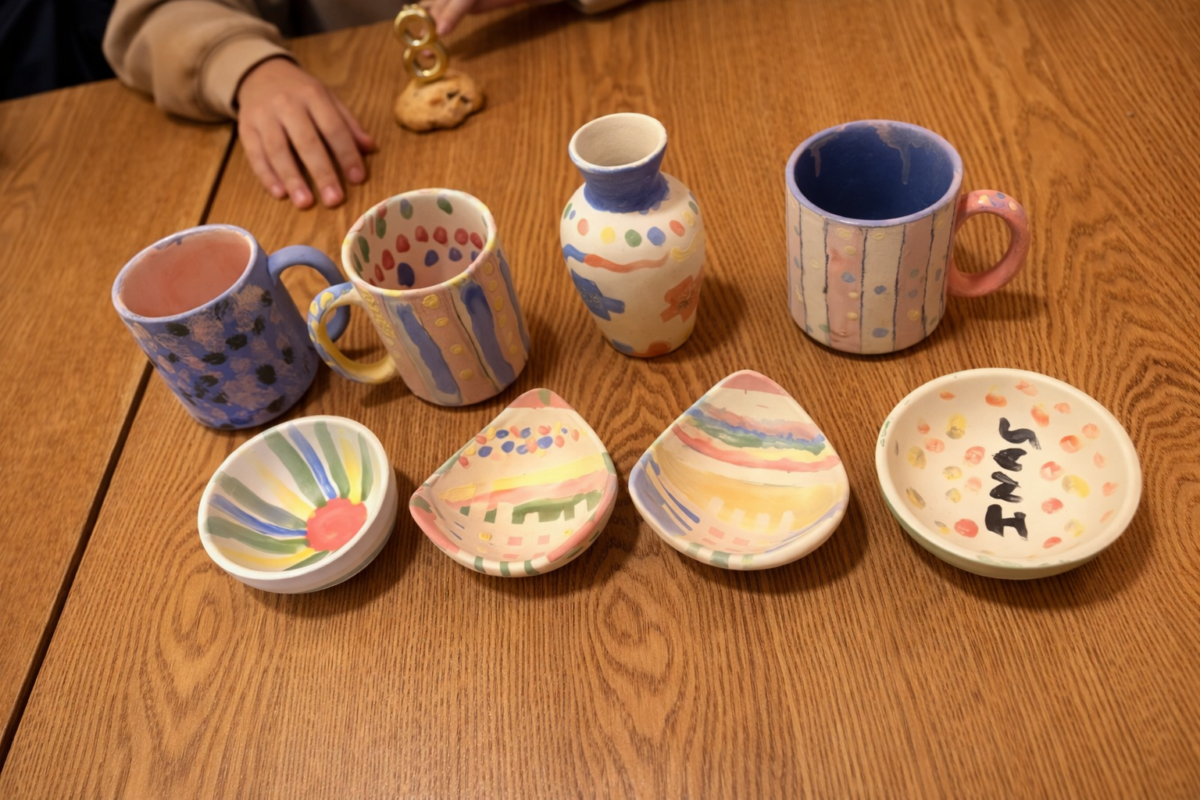
The simplest design and one of the most effective. Horizontal stripes in two or three colours on a mug or bowl. The trick is to use colours that contrast well: navy and white, black and terracotta, green and mustard yellow. No blending, no gradients, no complications.
2. Scattered dots and spots
Take a round-tipped brush, load it well with glaze and press it onto the piece without dragging. The result is perfect dots with no effort. Scatter them irregularly for a more organic look, or in neat rows for a more geometric result.
3. Coloured background with a white rim
Paint the whole piece in a solid colour and leave the top rim, about two centimetres, unpainted in white. It's one of those designs that looks difficult but is very easy to do. It looks especially good on mugs in dark colours: navy, bottle green, black.
4. Horizontal waves
Two or three wavy horizontal lines running across the piece. They don't need to be perfect; in fact, they look better with a little irregularity. With fluorescent glaze under UV light, the effect is especially striking.
5. Half-coloured piece
Paint the bottom half of the mug or bowl in one colour and leave the top half white or in the base colour. The dividing line doesn't have to be perfect. A slight irregularity gives it a handmade rather than mechanical look.
6. An initial or single letter
A single letter in the centre of a plate or on the side of a mug, with a fine brush and dark glaze on a light background. It's the most personal of the beginner designs and the one most often given as a gift.
7. Grid
Horizontal and vertical lines forming a grid over the piece. You can leave the squares empty, fill them with alternating colours or add a dot at each intersection. Three variations of the same design with very different results.
8. Geometric triangles
Triangles of different sizes spread over the piece, filled in or not. They don't need to be perfect: slightly irregular triangles have more character than ones drawn perfectly with a ruler.
Want to put these ideas into practice?
At Paint Barcelona, in the heart of El Born, everything is ready for you: UV glazes, brushes, the piece of your choice and the Print & Trace method to trace any design without needing to know how to draw. 100 minutes, from €15, and your fired piece is ready in 3 days.
Intermediate ideas for painting ceramics
These designs take a little more time and attention to detail, but they're completely doable without previous experience if you work calmly and in layers.
9. Simple five-petal flowers
Five brushstrokes around a central dot. It's the easiest flower to paint and the basis of many folk ceramic designs. Scatter them irregularly over the piece, vary their size and combine two or three colours.
10. Branches and leaves
A thin central line that starts at the edge of the piece and branches out, with small leaves on each side of every branch, each made with a single brushstroke. Green on white gives a very clean result. With lime green UV glaze on a dark background, the effect under black light is really eye-catching.
11. Inspired by Portuguese blue and white ceramics
Tile-inspired motifs: stylised flowers, decorative borders and geometric elements in cobalt blue on a white background. The result has a very recognisable look and is one of the most requested designs in ceramics workshops.
12. Tropical leaf pattern
Large green monstera or palm leaves spread over the piece without leaving much white space. Each leaf is made with a central line and side strokes that form the lobes. It takes a little practice, but the result is really striking.
13. Sun-inspired design
A central circle with lines radiating outwards. It can be very geometric, with straight lines of equal length, or more organic, with lines of different sizes and shapes. In yellow and orange on white, or in fluorescent white on UV black.
14. A fish or sea creature
A simple fish shape (oval body, fin and tail) with scales marked by small semicircular brushstrokes. It works especially well on bowls and plates. A more abstract variation is seaweed or wave shapes.
15. Text or a short phrase
A word or short phrase on the side of a mug or inside a plate, with a fine brush and dark glaze. The key is to plan the space before you start, working out how many letters there are and how to spread them out, so the result is centred.
16. Colour gradient
Two colours that gradually blend from one end of the piece to the other. Paint the lighter colour first, then add the darker one before the first dries, and blend where they meet with a damp brush. You need to work fairly quickly.
17. Checkerboard pattern
Alternating squares in two colours covering the whole surface of the piece. It looks simple but needs planning so the squares end up a similar size. It works really well on plates and tiles.
Advanced ideas for painting ceramics
These designs take more time to plan and paint, but the result is worth the effort. They're especially recommended if you've painted ceramics before and want a more detailed design.
18. Mandala
A mandala centred on the middle of a plate or bowl, with concentric layers of geometric motifs. The key is to start at the centre and work outwards, using the central point as a reference to keep it symmetrical. With neon UV glazes on a black background, the result under black light is spectacular.
19. Minimalist landscape
A simple horizon line, the silhouette of a mountain or tree and a gradient sky. Keeping it minimal makes the design more manageable than a realistic landscape, and the result is very elegant. In blue and white for a daytime look, or black and fluorescent white for a night-time effect under UV.
20. A continuous-line animal portrait
An animal drawn in a single line without lifting the brush, using the continuous-line technique. Dogs, cats and rabbits are the most popular because they're recognisable even with simple strokes. The trick is not to try to make it perfect: the imperfection is part of the look.
21. Klimt-inspired design
Gold motifs on a dark background, with patterns of circles, spirals and geometric decorative elements. Drawing on Gustav Klimt lets you work in great detail without needing figurative drawing skills. In gold and black glaze with touches of colour, it's one of the most striking designs for ceramics.
22. Scale or feather pattern
Rows of overlapping semicircles covering the whole piece like fish scales or feathers. Each shape is painted individually with a curved brushstroke. It takes patience, but the result is rich in visual texture.
23. Botanical illustration
Plants, flowers and leaves drawn in botanical detail: fine stems, textured petals, leaves with clearly marked veins. Botanical illustration on ceramics is a very popular look and works especially well on plates and large tiles.
24. Galaxy or cosmic effect
A black or dark blue background with white dots of different sizes for stars, soft patches of colour for nebulae and perhaps a planet or moon in the foreground. With UV glazes, the effect under black light is one of the most striking of all the designs on this list.
25. Your own design with the Print & Trace method
Any image you can imagine. At Paint Barcelona, in El Born, the Print & Trace method lets you bring any design (an illustration, a photo, a logo, a Pinterest reference), print it and trace it onto your piece with the help of UV light. That way, even the most complex design is within anyone's reach, with no need to draw freehand.
→ Book a ceramics session at Paint Barcelona
Tips for a great-looking design
Plan before you paint. Sketch a rough version on paper before you start. It doesn't have to be perfect, but it helps you see how the design will sit on the actual piece.
Start with the light colours. Dark glazes cover light ones, but not the other way round. Always paint the background and lighter colours first, and add the darker colours and details at the end.
Apply several thin coats. A single thick coat of glaze can crack in the kiln. Two or three thin coats also give more even coverage and a more intense colour after firing.
Don't trust the raw colour. Glazes change significantly in the kiln. White can become brighter, dark colours more intense, and some colours shift slightly in tone. Trust the process.
Mistakes can be fixed before firing. If something doesn't turn out the way you wanted, raw glaze can be wiped off with water and a damp cloth before it dries completely. Once dry, it can be covered with another coat of opaque glaze.
Where to put these ideas into practice in Barcelona
If you want to try any of these ideas with all the materials ready and no logistics to worry about, there are two go-to options in Barcelona.
Paint Barcelona, at Carrer de l’Esparteria 12 in El Born, works with fluorescent UV glazes that add a black light effect to any design. The Print & Trace method makes complex designs accessible to anyone. Pieces are ready to collect, fired, in 3 days. From €15 per person.
La Pintoràmica, with studios in Gràcia and El Born, offers more than 100 different pieces to choose from and works with traditional glazes. A calmer, more traditional atmosphere. Also from €15 per person.
→ See ceramics sessions at Paint Barcelona
→ See workshops at La Pintorámica
Frequently asked questions
What's the easiest thing for beginners to paint on ceramics?
Simple geometric designs (stripes, dots, half-coloured pieces) are the most accessible. They don't need a steady hand or complex planning, and the result always looks good.
How are designs fixed on ceramics?
Ceramic glazes are permanently fixed by firing at high temperature in the kiln. Without firing, the glaze doesn't set and can wear off with use and washing.
Can I bring my own design to a ceramics workshop?
Yes. At Paint Barcelona you can bring any reference (an image on your phone, an illustration, a photo) and the team will help you trace it onto your piece with the Print & Trace method.
Do UV designs look the same in normal light?
They're visible, but they look different. In normal light, UV glazes have bright, intense colours. Under black light, the colours glow with an intensity conventional glazes can't achieve. The piece has two distinct looks.
How long does it take to paint a ceramic piece?
It depends on the design. A simple design can be done in 30-40 minutes. A more elaborate design with several coats may take the whole 90-120 minute session. At Paint Barcelona and La Pintorámica, sessions are timed so that any design can be finished within the session.